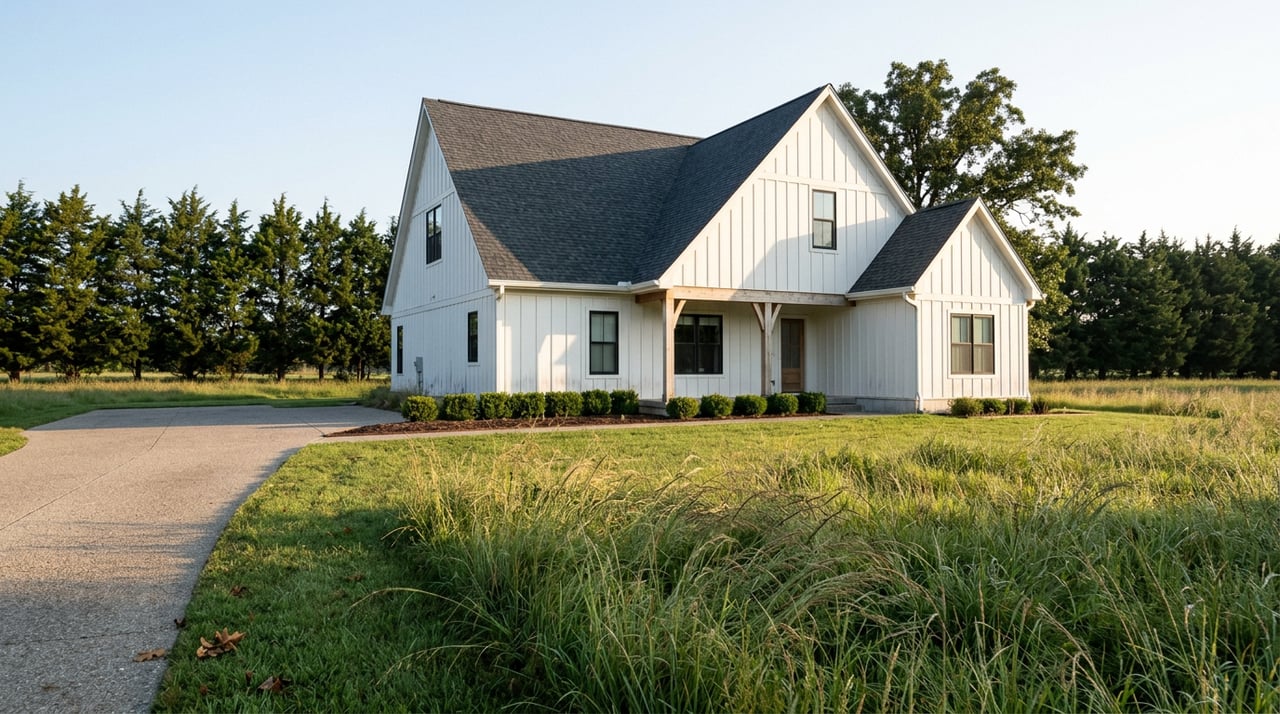
A ten acre lot outside Trafalgar can list for a fraction of what the same ten acres would run inside Greenwood city limits. That's the number most buyers see first, and it's the number that gets repeated at dinner tables and in group texts: land out here is cheap.
It isn't wrong. It's incomplete. The price per acre on a listing near Trafalgar can mean four different things depending on what's actually growing, standing, or buried on that ground, and the paperwork that protects you when you buy a house does not automatically follow you when you buy dirt.
The Form That Doesn't Follow You Onto Vacant Land
Every Indiana home buyer eventually hears about the Seller's Residential Real Estate Sales Disclosure, the state's Form 46234. It's the document that makes a seller put in writing what they know about the roof, the septic, the foundation, and the well before an offer gets accepted. It exists because Indiana Code 32-21-5 requires it for property with four or fewer dwelling units, and the Indiana Real Estate Commission's rule spells out exactly what has to be on that form.
Vacant land doesn't have a dwelling unit. According to Avvo, Form 46234 doesn't apply to it. What gets filed instead is a different document, the Sales Disclosure Form, State Form 46021, built for the county assessor rather than the buyer. It records who bought what, what they paid, and how the parcel is classified: residential, agricultural, vacant land, or something else. It doesn't ask whether the well runs dry every August, whether there's an easement across the back forty for a neighbor's driveway, or whether the parcel has ever failed a perc test.
That gap isn't a loophole anyone is working. It's just how the law was built, on the assumption that raw land carries less to hide than a house does. A ten acre parcel near a growing corridor can still carry plenty worth knowing: a farm lease that runs through the end of the year, road frontage too narrow to legally split the lot later, deed restrictions written into a decades old subdivision plat. It shows up because you asked.
One Price Per Acre, Four Different Products
Search for land near Trafalgar on any major aggregator and the average price per acre changes every time, sometimes by tens of thousands of dollars. That's not sloppy data. It's four different products getting folded into one number.
| Land type near Trafalgar | Average listing price | Average price per acre |
|---|---|---|
| General land for sale | $1,660,428 | $60,654 |
| Residential, buildable land | $798,257 | $58,231 |
| Houses sold with acreage | $793,350 | $66,579 |
| Waterfront-adjacent land | $1,018,575 | $46,420 |
| Johnson County, all land types | $1,004,258 | $96,435 |
Those figures came from active listings pulled the same week, within roughly the same radius. The spread exists because a wooded ten acres with no road frontage and a flat, utility-ready lot inside a platted subdivision aren't comparable goods, even if they sit a mile apart.
The confusion goes deeper than one aggregator disagreeing with another. One land-data service ranks Johnson County sixth out of Indiana's 92 counties for total acreage currently advertised for sale. A second ranks the same county 32nd on that exact measure, in the same season. Both agree on one detail: Greenwood carries more listed acreage than anywhere else in the county, which tells you where the volume sits even when the rankings don't agree on how much.
The county's actual sales tell a similarly split story. In 2024, the highest recorded farmland sale in Johnson County closed at $17,307 an acre for prime, tillable cropland, a fraction of what land marketed for building or recreation commands in the same county today. Cropland and homesite-ready acreage are priced by entirely different logic, and no single average can hold both at once.
The Invoice That Arrives After Closing
A buyer who's sorted through four price-per-acre numbers and landed on the right land type still hasn't found the real cost of a homesite. Most acreage around Trafalgar sits outside city water and sewer.
A perc test, the soil evaluation a septic permit depends on, runs anywhere from a few hundred dollars to a few thousand, depending on how many holes the county requires and whether the soil needs an excavator instead of a hand auger. Johnson County's own Onsite Septic office issues those permits and sets the local requirements for how a given parcel gets tested.
Assuming the soil passes, a straightforward well and septic installation on raw land runs somewhere between $10,000 and $35,000 combined, based on multiple 2026 rural construction cost guides. Difficult soil moves that number fast. Heavy clay or a high water table can push a buyer into an engineered or mound system, and the septic portion alone can climb past $25,000 before the well is even priced.
None of that shows up in the per acre figure. It shows up in the second round of quotes, after closing, once the actual soil report comes back.
Why the Corridor Matters More Than the County Average
The reason Trafalgar's land market behaves differently than the countywide average is visible from the SR-135 and SR-252 intersection. That stretch already has a McDonald's, Taco Bell, Burger King, Subway, and Dairy Queen, and Indian Creek High School sits less than a mile away. Large, flat, floodplain-free acreage near that intersection gets marketed to builders and developers specifically because rooftops and traffic are already established there.
The town has said as much on the record. At Trafalgar's first official State of the Town address in March 2026, officials framed the moment, in the Daily Journal's coverage, as one where "growth was on the horizon." That's a town government publicly betting on the corridor, a different kind of signal than a listing agent's marketing language.
For a buyer, that context changes what a given price per acre is actually paying for. Ten acres near the SR-135/252 corridor is paying for proximity to that growth. Ten acres a few miles out near Sweetwater Lake, Cordry Lake, Princes Lakes, or Lamb Lake is paying for recreation and privacy instead. Both get called land near Trafalgar. They are not the same purchase, and they shouldn't be priced against each other as if they were.
Five Questions Worth Asking Before the Per Acre Number Talks You Into Anything
Once you've found a parcel that fits, these are the questions that separate a good price from a good deal:
- What classification does this parcel carry on its sales disclosure form, residential, agricultural, or vacant land, and does that match how it's been marketed to you?
- Has a perc test ever been run on this specific parcel, and can the seller produce the written result?
- Is there an existing well or septic system in place, and when was it last inspected or pumped?
- Does the road frontage support splitting the parcel later, or is this acreage locked into one sale permanently?
- Is there a farm lease, hunting lease, or easement attached to the land that will survive the closing?
All five are answerable if you ask before you write an offer, not after.
A Few Questions Buyers Ask Us Directly
Does Indiana require any disclosure at all on vacant land sales? Yes, but not the same one buyers expect. The detailed condition disclosure required for houses only applies once a dwelling exists on the property.
Why do two listings a mile apart show wildly different price per acre? Because land isn't one product. A landlocked recreational tract and a utility-ready building lot get priced on different logic even when they're neighbors on the same road.
Does every parcel around Trafalgar need well and septic? Only if it sits outside city water and sewer service, which describes most acreage in the area. Parcels closer to town utilities can skip that cost entirely, which is one more reason not to compare two listings acre for acre without asking what's actually underground.
Let's Price It the Way an Appraiser Would
Pricing land by the acre is easy. Pricing it by what you can actually build, farm, or resell it as later takes someone who has stood on both sides of an appraisal and a construction site. If you're weighing acreage near Trafalgar or anywhere else in Johnson County, Amanda Cottingham Johnson can help you read a parcel the way an appraiser reads it before you write an offer, not after. Let's Connect.
This article is general information, not legal, tax or financial advice. Consult a qualified professional about your situation.
